Get Consultation from Experts
First Chat Free
Sign In
Enter your mobile number to continue
By signing in, you agree to our Terms Of Use and Privacy Policy
Download Our App For Better Experience


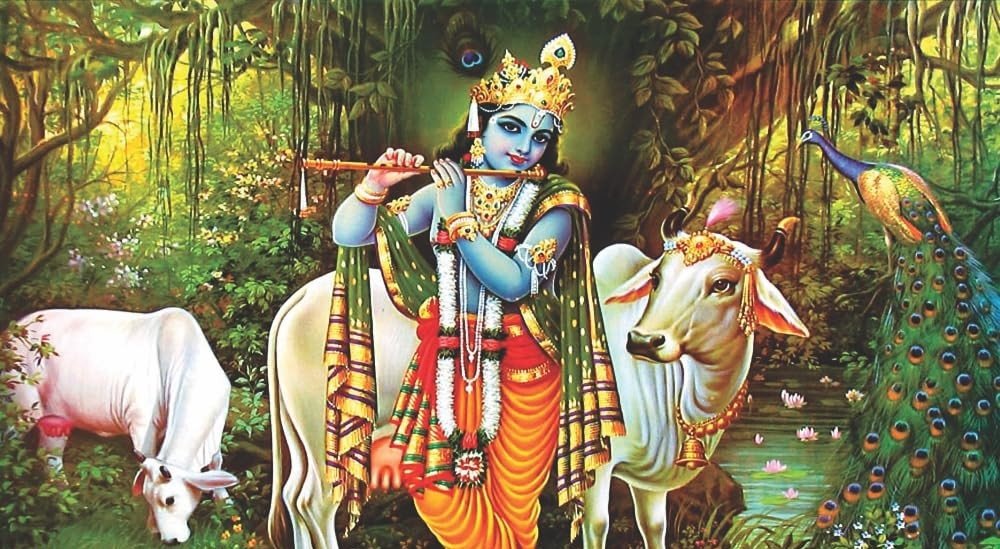
Shri Krishna is one of the most loved and worshipped deities in Sanatan Dharma. Known as the eighth incarnation of Lord Vishnu, Krishna represents love, wisdom, compassion, courage, and divine joy. Throughout Hindu scriptures like the Mahabharata, Bhagavad Gita, Bhagavata Purana, and Vishnu Purana, Lord Krishna is described with many beautiful names, each carrying a deep spiritual meaning and a divine story.
Every name of Shri Krishna reflects a unique aspect of his personality, childhood, divine powers, and relationship with devotees. From the playful child of Vrindavan to the supreme guide of the Bhagavad Gita, Krishna’s names continue to inspire millions of devotees around the world.
Here are 9 powerful names of Shri Krishna and the stories behind them.
The name Govinda comes from the Sanskrit words “Go” meaning cows, senses, and Earth, and “Vinda” meaning protector or finder. Lord Krishna was lovingly called Govinda because he protected cows and cared deeply for the people of Vrindavan.
One famous story associated with this name is when Krishna lifted the Govardhan Hill on his little finger to protect villagers from heavy rains sent by Lord Indra. From that day, devotees started worshipping him as Govinda, the divine protector.
Govinda symbolizes protection, compassion, and divine care for all living beings.
Gopala means “the protector of cows.” During his childhood in Gokul and Vrindavan, Krishna spent most of his time playing with cowherd boys and taking care of cows.
His innocent flute melodies and playful nature made everyone in Vrindavan fall deeply in love with him. The image of young Krishna with cows remains one of the most beautiful symbols in Hindu devotion.
Gopala represents innocence, simplicity, love, and harmony with nature.
Krishna is also known as Madhusudana, which means “the destroyer of the demon Madhu.” According to scriptures, the demon Madhu spread evil and chaos in the universe. Lord Vishnu defeated him to restore peace and righteousness.
As an incarnation of Vishnu, Krishna carries this divine title symbolizing victory over negativity and evil forces.
Madhusudana teaches devotees that truth and righteousness always triumph over darkness.
The name Murari comes from the story where Krishna defeated the powerful demon Mura. The demon created fear among gods and humans, but Krishna destroyed him with divine strength.
Because of this victory, devotees lovingly started calling him Murari.
Murari symbolizes courage, protection, and the destruction of fear and negativity.
Kanhaiya is one of the sweetest and most affectionate names of Krishna. It was lovingly used by Mother Yashoda and the people of Vrindavan during his childhood.
Little Krishna was famous for stealing butter, teasing the Gopis, and spreading happiness everywhere. His naughty and playful nature made him everyone’s favorite child.
Kanhaiya represents joy, unconditional love, and childlike innocence.
Krishna is called Vasudeva because he was born to Vasudeva and Devaki in Mathura. His birth itself was miraculous. King Kansa, Devaki’s brother, feared a prophecy that Devaki’s eighth child would destroy him.
To protect baby Krishna, Vasudeva carried him across the Yamuna River during a stormy night to Gokul, where he was safely raised by Nanda and Yashoda.
Vasudeva symbolizes divine destiny and protection from evil.
During the Mahabharata war, Krishna became the charioteer of Arjuna, who was also known as Partha. Therefore, Krishna earned the name Parthasarathi, meaning “the charioteer of Partha.”
On the battlefield of Kurukshetra, Krishna delivered the sacred teachings of the Bhagavad Gita, guiding Arjuna through confusion and fear.
Parthasarathi represents wisdom, guidance, and the importance of dharma.
Krishna is often called Shyam because of his dark blue complexion, which is compared to rain-filled clouds and the infinite sky.
Despite his dark appearance, Krishna’s beauty, charm, and divine aura attracted everyone around him. Devotees describe Shyam as the embodiment of divine love and attraction.
Shyam symbolizes divine beauty, spiritual depth, and infinite consciousness.
The name Jagannath means “Lord of the Universe.” This form of Krishna is especially worshipped in the famous Jagannath Temple in Puri, Odisha.
Lord Jagannath represents Krishna’s universal form, showing that he belongs to everyone regardless of caste, religion, or background. The grand Rath Yatra festival celebrated every year attracts millions of devotees from around the world.
Jagannath symbolizes universal love, equality, and divine connection with all beings.
Shri Krishna is more than a deity; he is a symbol of eternal love, wisdom, devotion, and divine joy. Every name of Krishna carries a powerful story and spiritual lesson that continues to inspire devotees across generations.
Whether worshipped as Govinda, Gopala, Murari, or Jagannath, Krishna teaches humanity the path of love, righteousness, and devotion. His life reminds us to face challenges with courage, perform our duties with sincerity, and stay connected to divine truth.
Even today, the chanting of Krishna’s names fills hearts with peace, positivity, and spiritual energy.
“Hare Krishna Hare Krishna, Krishna Krishna Hare Hare
Hare Rama Hare Rama, Rama Rama Hare Hare.”
Janmashtami, also known as Krishna Janmashtami or Gokulashtami, is one of the most sacred and joyful festivals in Sanatan Dharma. It celebrates the birth of Lord Shri Krishna, the eighth incarnation of Lord Vishnu, who was born to destroy evil and establish dharma (righteousness).
According to Hindu scriptures, Krishna was born at midnight in the prison of Mathura to Devaki and Vasudeva during a time when the cruel king Kansa spread fear and injustice across the kingdom. A divine prophecy had declared that Devaki’s eighth son would become the reason for Kansa’s downfall. To save baby Krishna, Vasudeva carried him across the Yamuna River on a stormy night to Gokul, where he was lovingly raised by Nanda Baba and Mother Yashoda.
Janmashtami is celebrated with immense devotion across India and many parts of the world. Temples are beautifully decorated with flowers, lights, and Krishna Jhankis that depict scenes from Krishna’s childhood. Devotees observe fasting, sing bhajans, chant Krishna mantras, and stay awake till midnight, the sacred hour believed to be Krishna’s birth time.
One of the most famous traditions during Janmashtami is Dahi Handi, especially celebrated in Maharashtra. Inspired by Krishna’s childhood habit of stealing butter with his friends, young groups form human pyramids to break a hanging pot filled with curd, butter, or sweets.
The festival is not only about celebration but also about remembering Krishna’s teachings of love, devotion, truth, and righteousness. The Bhagavad Gita, spoken by Lord Krishna on the battlefield of Kurukshetra, continues to guide millions of people toward a meaningful and spiritual life.
Janmashtami reminds devotees that whenever darkness and negativity increase in the world, divine energy always arrives to restore balance and protect humanity.
“Whenever there is decline in righteousness and rise of evil, I manifest myself.” — Bhagavad Gita